Naked Wines Might Consider Suspending New Angels Applications .

Hot off the presses, Naked Wines founder Rowan Gormley commented in an interview with the financial press that business was so good for the three members (UK, US, AUS) of the Naked Wine family that he would consider limiting New Angel Applications and creating waiting lists to assure that the wine supply and quality controls can keep up with the demand.  This option would likely be applied to the three member companies on a case by case basis and only to balance supply and demand issues.  It is purely a growth management issue and not related to any other issue. A link to the source article is imbedded above.

Posted in Uncategorized | Leave a comment

When is a Wine Ready to Drink — Know When to Hold-em and Know When to Serve-em.

One of “Poor Robert’s” readers asked me how I know when a wine is ready to drink.  I thought about it and realized, I really do it intuitively.  I’ve been drinking wine so long, I just have a sense with each different wine type, by region by color, by variety and even then I don’t always get it right.  I knew that wouldn’t be a satisfactory answer so I decided to consult a few others and see what the mighty internet had to say.  Sadly I got pretty much the same answer from most of my sources, but I think I can construct a cogent blog to help wine drinkers develop their own sense of when a wine’s time is right.

The biggest issue in figuring it all out is the chemistry of the wine, in particular the tannins and acids each particular wine exhibits.  Generally white wine grapes produce less and the darker the red grapes the more they exhibit.  The individual palate also plays a factor in how the acids get perceived.  Some of us like wine with heavy tannins and other don’t, but no matter where you fall in the spectrum you will have an opinion. If you sit and drink with a good book on the deck in the sunshine or by a cozy fire in the winter it is one thing, if you are entertaining you will need to consider the likely tolerances of your guests.  If you are eating a steak or seared scallops, it will make a difference.  So how do you decide what wine to serve and if it’s ready.  The answer can be, glibly, simple — open it and see, or it can be more complex if you don’t have  years of experience opening wrong bottles for the occasion or drinking them two young.  The rest of this post will try to demystify the process and provide some simple tools I’ve developed over the years. I’ll share a few rules of thumb later in the post to help avoid trouble with decisions, but they are not engraved in stone. The answer for each of us differs, just as our personalities and ethos.  So here goes

White wines drink younger than most Reds and so when you pick up a 2013 white wine it will generally be ready to drink right now to about 2016 or 17, but beyond that you risk having the natural aging and oxidization process take the joy out of the experience.  It can become bitter and metallic and when it does you know it.

Red Wines drink ??  Deciding when to drink Reds poses a bit more of a problem as Reds cover a broader range of Grape Varieties and considerably more styles of wines. Big Bordeaux and Cabernet Sauvignons will require more age than say a Pinot Noir or fresh light Merlot.  Where the grapes originate and the style of vinting will also paly a part in the decision of when to drink a red wine.  Conversely they will also drink well for a longer period of time.

Now to complicate the decision making process even more, wine making has made huge advances in the past several hundred years, but particularly in the last thirty to forty or so as enology has advanced and developed ways to lighten the tannins earlier in a wines life to allow for earlier consumption.  Except for a few prominent really big (did I say expensive) wines most are made to be consumed starting two to four after fermentation.  If you notice in the markets, we have just begun to see better Reds with 2012 and 2013 vintages, while we have seen 2012 and 2013 vintages of the better whites for a while longer.  Good modern wine makers don’t release a wine much before it can be consumed (remember what I said about big expensive wines).  Society has pushed the use by date forward with significant growth in demand.

Right now I am drinking Reds with vintages of 2012 and older (usually older).  I have consumed a few 2013s, but, primarily because I am tasting them to review.  I am drinking Whites 2013 and older because they are mostly ready.  The good news — if a wine is not ready it generally can be fixed.  If you happen upon a bad or “corked” bottle (very infrequent) you will definitely know it.  It can even smell foul or like gasoline and if you taste it the bitterness, and sour after taste will be evident.  this wine is toast and can’t be salvaged.  When I am tasting a wine to review I will taste it five or six time (same bottle): (1) when I open it I want to see it’s nose, acidity and tannins right out of the gate, (2) next after I  aerate it into a decanter to see what impact aeration has on the same three factors, (3) after awhile (time determined by the degree of tannin in the first two) I’ll taste it again to see how it changed, if at all (4) then I’ll drink it with an appropriate meal and then I almost always leave a third of the bottle re-cap it and leave it in my cellar for a couple of days so I can observe the change, (5) the next day and (6) if the change has been significant I’ll do it again after seven days exposed to air (in the capped bottle).  This process allows me to gage what the wine will be like over a number of years as the forces oxygenation over time gives me a window into what up to five or so more years of capped bottle aging will do to the wines character.

Why do I care about all this, well simply it tells me when this wine will likely be at its peak for my palate.  If I see a lot of change (improvement in flavor and experience) from the beginning to the end of the process it tells mw that the wine has a lot of time left in the bottle and I can age it.  If there is little improvement or the wine starts tasting metallic at any point it tells me that it’s time to start consuming it as it is near in the end of its enjoyable life. As a case in point I opened a 1996 Bordeaux the other day and saved a bit in the bottle overnight and it started to turn in a single day.  I will be drinking the rest of my stash of this wine this year as it will not improve from where it is today and right now it is really mellow and wonderful.  This is quite common with older wines.

Now for Robert’s Rules of  (thumb) Order:

  1. Whites go with Fish and light meals — I generally agree, but I really like sweeter whites with spicy Hispanic food and love Sauvignon Blanc with simply grilled Lamb chops.  In the same vein, I really like Pinot Noir with grilled Salmon and any smoked fish.  Remember a whole spectrum of whites exist from the super sweet on one end to the very dry and the nature of the wine has a great deal to do with what you do with it.
  2. Reds go with meat — Again I generally agree and I’ve already noted a few exceptions in the white discussion.  If you grill and char you red meat go with a bigger Red Bordeaux, Cabernet Savignon, or a Malbec.  If it is pork, try a Merlot, Petite Syrah, a Shiraz or a Pinot Noir or a big Chardonnay.
  3. Fowl goes both ways —  We generally think of white wine with fowl, but especially with game birds, any of the reds you would drink with Pork go with go really well with fowl.
  4. Always decant red wine — maybe but taste it first, it may not need it.  With really older wines I decant and serve for the sole purpose of relieving a little of the must and it will have a lot of sediment that needs filtering out.
  5. Sediment in wine is bad — This is true to the extent that it is annoying to drink wine with sand or grit in it, but is doesn’t ruin the wine.  just remove it by filtration.  Wine filters are best, but cheese cloth and in a pinch a coffee filter will do.
  6. Vintages do make a difference — This is true, especially for big reds.  It also applies to all other wines, as it will impact character changes between different vintages and when a particular vintage drinks best.  Some will require more age and others less based on the vintage.  Watching for these differences is part of the fun of wine tasting
  7. Always keep a wine diary or journal — If you’re into comparing vintages of the same or similar wines this is a great idea.  If you are just into enjoying the bottle in the moment, it is not necessary and only provides value when you can’t remember a wine and want to serve it again.

Well have I covered it all?  Not by any stretch of the imagination, but what I have done is provide a little information that enables each of you to learn how to decide when a wine is right for you and to develop your own style and sense of direction.  Most of all wine must be enjoyed so treat it (serve or store) so that you enjoy each wine experience as they come along.


Posted in France, Hodgpodge, Uncategorized, Varietals, Wine Buying, Wine Tasting, Winemaking, Wines | Tagged , , , , , , , , | 16 Comments

What’s in a Blended Wine and When is a Varietal not a Varietal

As I was preparing to write this post I spent a lot of time on the internet and digging through a lot of technical stuff that might have made sense in the 1600s or 1700s but sure did not make sense to me today.  While dredging through all this stuff I came across an article from Wine Enthusiast (Author unknown) that really made me laugh  He or she used ice cream as a metaphor for wine (I know this is a stretch).  quoting with attribution to Wine Enthusiast ” Vanilla Ice Cream is all right on its own but it definitely benefits from a dollop of chocolate syrup”  I want you to remember this quote as I’ll come back several time to it later in the blog.  It is really true and aptly applies to wines as well .  A classic California Cabernet Sauvignon may be great, but add a dollop of Merlot and it is even better.  This is really what wine is all about today, differentiation and making the vanilla ice cream better with a dollop of chocolate, strawberry, huckleberry or caramel. So how extensive is blending, how did it start, how can I tell and what does it all mean to me.

For starters the bottle of wine you buy may not always be what you think and that isn’t such a bad thing, blending has been going on for years. The law in the United states (federal Labeling regulations)  require that in order to put a varietal name on a wine label it must be at least be 75%  that grape and the other varieties need not be disclosed on the label.  Think about that, the expensive Cabernet Sauvignon you just bought might be watered down by other grape varieties.  Is this a bad thing? Maybe, Maybe not, it all depends on the winemaker’s motivation.  If they dump in lesser grapes from poor quality stock to get the price down it could be a downer to it’s loyal customers.  On the other hand to reference the ice cream, a dollop of quality Merlot has mellowed many a Cabernet Sauvignon and made it a much better wine.  This is especially true with wines we see in the markets today.  A young Cabernet Sauvignon (100%), good grapes and vinting technique not withstanding, will likely be very tannic until it has age under its belt.  If I am grabbing a bottle to take to a friend’s home for dinner that I know we will drink tonight I want something good (at least okay).  Do I grab a bottle off the top shelf, with its top shelf price, because it’s a good older vintage, or do I hit the middle shelf and get one that I know is a good early drinking blend.  Minto is a Scots name so you figure it out.  Blending gives us a lot more flexibility in what we can drink and when.

Blending has been going on in Europe for centuries and many of the classic big wines: Bordeaux, Chianti, Cote du Rhone, to name a few, are almost all blended.  In fact, many of the older wine houses have proprietary recipes that have been handed down for generations. By law in order to call a wine a Bordeaux  it can only  contain one or more of the following wines: Cabernet Sauvignon, Merlot, Malbec, Petite Verdot, Carmenere and Cabernet Franc all of which must be grown in the Bordeaux Appellation.  So what is a Bordeaux?  With no limitations as to amounts, no required ingredients I now understand why the same vintage of  different Chateaus can be so different.  In Rhone regions of France winemakers mix up a variety of  15 different grapes to concoct Chateauneuf-du-Pape, Cote du Rhone and Cote Rotie. Granted they generally don’t use all fifteen at once, but the latitude is great and the styles have gained a great deal of consistency over the centuries.

In Italy for years Chianti has been a blend of principally Sangiovese (major ingredient) with Canaiolo, Malvasia Blanca or Trebbiano.  Only recently have the Italian wine authority ( Denominazione Origine Controlla e Garanta — DOCG) allowed the production of 100% Sangiovese wines under the Chianti name.  Notice the inclusion of the Malvasia Blanca (white wine) in the list.  It has been a leading minor ingredient for many Chianti producers to provide a little mellowing to the Sangiovese to allow it the appeal to a broader palate and allow it to be consumed younger.  Even in Italy wine drinkers have become more impatient.  On a side note, you may have seen “Super Tuscan” blends in the markets.  These wine actually violates the DOCG rules and until recently were required to be labeled as “table wines” a much lower class of wine than the major denominations considered to be much superior.  Time fixes every thing (maybe) and recently the DOCG gave them their own denomination — Indicazione Geografica Titia or IGT for short.  It’s still not a superior denomination, but its better than “Table Wine”  In fact, referencing the previous ice cream metaphor, if one variety of ice cream is a cone, these super wines might just be considered the ultimate ice cream sundae.

Moving to our side of the pond I’ll wax nostalgic and give the younger generation a picture of life in the olden times (before 1970) when American winemakers produced principally two wines “Burgundy” (Pinot Noir grapes — primarily) and Chablis (Chardonnay grapes-primarily).  I am intentionally leaving out the lesser stuff which all the children of the “60s” want to forget like Boones Farm and MD20/20. Trust me it was another time and place which is best left in its cloudy reverie  We consumed a lot of marginal wine back in the day and much of it came in gallon jugs and factually was pretty watery stuff.  Then came the 1970’s when the winemakers looked east across the pond and realized that they too could produce really good wines and the era of single varietal wines came into being and the industry blossomed to what we have today.  The various states drafted up their own purity laws like most of Europe and quality control became the order of the day.  Oregon has by far the strictest such provisions requiring Varietal Wines to contain 90% varietal grapes to be permitted to use the wine’s varietal name on the label.  Most of the rest of the wine growing world (USA world that is) adheres to the federal labeling standard of 75%.

One of the more interesting developments in this process came with the question; what happens if we replicate a classic Bordeaux blend in the United States, can we call it a Bordeaux.  The answer is clearly no, so “Meritage” was born and with its birth came its own strict (mostly) set of standards of purity.  Of course along with that came a regulator, the “Meritage Association” which must approve this uniquely American “Bordeaux style” wine before it can use the “Meritage “brand on its label.  These “Meritage wines are some of the best in the world and rival a classic Bordeaux both in quality and price.

Okay what happens if we use less that 75% of one varietal in a wine, what do we call it in America?  Answer — Anything you want as long as it doesn’t use a varietal name on the label.  If you go to the supermarket and look on the middle shelves you will see some really strange labels and names and mostly they will change from year to year.  That’s the beauty of wine making today, you can still produce a blend that carries a $20.00 price tag and not worry about branding, vintages or varietals.  Mix up whatever grapes are handy and presto you have instant success or failure.  If it succeeds you try to remember what you put in it and it becomes a brand (e.g. Three Legged Dog — one of my favorites, or Two Buck Chuck — one of my least favorites).  if it was a failure you design a new label and try again next year.  I actually like this free form part of the industry.  On the other end of the wine spectrum we find the elite proprietary brands, Insignia, Opus, Dominus, Isosceles, Ovid and Rubicon to name a few which meticulously craft blended wines that trade for in excess of $200 a bottle.  I confess that they are not abundant in my cellar as they hit the upper extreme of my budget about $125 ago.

Fast forward to today and blending is no longer just the province of the winemaker.  Wine Bars all over let patrons blend their own wines with some degree of chemical precision.  Even NakeWines.com  tasting rooms have this on the menu.  It’s actually neat to be able to sit down in a quiet (or not) environment  with a bunch of bottles in front of you, a measuring beaker and a wine glass and precisely blend up you own super wine by adding different ingredients and seeing what you like and don’t, what works for you and what doesn’t without buying the entire bottle and finding out you hate it.  I suspect we will see more of this cropping up  as it’s a fun way to while away an evening.  By the way I don’t recommend trying this at home as you are likely to start with wines that have already been blended to a degree and the results will never match up to those where you begin with pure varietals.

Well this has been fun, but I  hit my own self imposed limit of 1500 words a while back.  I want to captivate my readers, not put them to sleep so I’ll close this blog out with the promise to dig deeper into blending and perhaps bring back some country specific blending blogs later on.

Posted in France, Hodgpodge, Naked Wines, Uncategorized, Varietals, Winemaking, Wines | Tagged , , , , , | 10 Comments

What’s In A Wine Glass — Besides Wine?

I’ve consumed wine in just about every sort of vessel, from paper cups, plastic wine glasses mason jars and all sort of fancy wine goblets. I’m even old enough to remember when a wine glass was small and only came in one shape. So the real question — does it really make a difference what sort of glass you use to drink wine? I actually did a lot of research into this question and will try to makes some sense out of what at first seems like a huge marketing ploy by the glass  and crystal manufacturers of the world.  I’ll try to provide some unbiased perspective and then provide enough information to help readers decide what’s right for their wine consuming pleasure.

I’ve concluded that the type of glass you use really depends on what you want out of the wine experience.  There are some authors on the subject that make a big deal out of shape and believe that modern glass designs funnel the wine to the correct part of the tongue to get the greatest impact out of the sensory aspects of each individual wine.  As near as I can tell there is now scientific basis for this claim, but it sounds good for those that want to impress as part of the wine experience.  For the most part glasses come in four basic shapes, Red (bigger and rounder), White (smaller with narrow mouths), Sparkling (tall and slender), and Desert (really small); two basic styles, goblets and tumblers, made from two basic materials crystal and glass.  There you have it what else do we need to know? actually not much, but there is a lot out there to learn and some of it is actually pretty interesting.

Material:   The debate about crystal or glass spans from snob appeal to actual functionality.  Glass is cheaper and more durable, but crystal (yes lead crystal) can be shaped much thinner and on a micro level it has a much more open cell structure that some believe actually allow the wine to breath (oxidize) more quickly providing a more pleasing wine drinking experience in today’s impatient world.  For those of us that like to focus on the a wines color, crystal will provide more refraction and allow for easier definition of color differences between wine.  Personally, I drink wine and don’t spend a lot of time contemplating it except when I actually review it so this aspect of crystal is pretty much not a factor for me.  Oh, I forgot plastic!  I never use the stuff unless I am at a really lowbrow affair somewhere and any kind of a glass vessel is not available.  I am not wine snob but even I try to draw a line somewhere and plastic is below that line.

Size: Here I do think we may really see some differences.  Red Wines as a general rule have more aroma or bouquet and being able to get your nose down in the glass, especially right after it’s poured makes a difference to some who really enjoy the nose of a wine as much as the taste.  In addition bigger, rounder glasses (bowls to some) provide more breathing surface and allow oxidization to occur more quickly and provide a better wine drinking experience. White Glasses tend to be smaller and have narrower openings.  This in part impedes the oxidization which most deem desirable for all except the oakiest of Chardonnays.  I also believe that it requires them to be filled more often  and as most of us like our white wines chilled it lets us consume the glass quantity more quickly and thus keeping the wine in the glass colder as we refill.  Sparkling Wine Glasses have come a long way from what we call sorbet goblets of old to the modern flutes.  From a sensory perspective each has it’s advantages, but I personally prefer flutes as the mouth of the glass is as wide as the widest part of the glass and allows for the concentration of the bubbles into a smaller opening to tickle my nose (just kidding) and does a better job of retaining the wines natural bubbles in the glass longer.  Desert Wine Glasses come in several shapes, but generally are tiny by comparison to the bigger red and white glass.  Most intend to hold only one to two ounces of wine at a pour and focus more on taste rather than presenting bouquet.  For most these glasses are a luxury.  A small amount of dessert wine poured in a sparkling wine flute or a small white wine glass works just fine.

Style:  Most agree that this is the least significant part of the wine glass decision process and also agree that tumblers present a casualness and goblets a flair that pretty well defines their respective place at the table.  I for one have more of both than I can use and I almost always default to the tumblers.  My reasoning is simple — I am a bit of klutz and I am less likely to spill a tumbler of wine (especially red wine) all over my wife’s really old and elegant linen table cloths.  Seriously, most of my wine consumption is not at fancy dinners but rather in my study/wine room or around an everyday dinner table.  When I was young and poor as, opposed to old and a little less poor , my wine glasses consisted of pint mason jars for red wines and half-pints for whites — not kidding.  I still use them today as Bar-BQ barware for the patio and the deck.  They are perfectly functional and make for good conversation around a hot outside grill.  I must digress and tell you all to type “redneck wine glasses” into your browser when you finish this blog.  It may surprise you what you see yep — mason jars with stems, for those fancy occasions when plain mason jars just won’t do.

The ultimate question of what you really need to enjoy wine is  very personal and I am not going to try to help with that.  If you are just beginning to enjoy wine, keep it simple until you find how and when you drink most of your wine and the kinds you really like.  You can invest in Riedel or Eiche  crystal  (about $50.00 per pair) and spend a fortune if you get the whole varietal series of both tumblers and goblets, or you can hit our local bar supply house or superstore and get a set of four each, red, white and sparkling for about the price of two crystal glasses.  In the alternative you can hit the grocery store and buy a six pack of mason jars (pint and half-pint) for about the same price.  It’s all about you style and what you feel comfortable with.  Personally I use tumblers most of the time and I really enjoy them.  The nose and taste is important to me as is the feel of the glass as I sit and enjoy a relaxing glass of wine while reading a book or in casual conversation at the dinner table, so I opt for what makes me comfortable in the particular setting.  Remember that those of you who are not antique like me have a lifetime to collect the set of wine glasses you want to be drinking from when your kids get ready to inherit them.

So, some information and no real answers.  Get on the internet and check out wine glass outlets (many to choose from) and Wikipedia which has a great article on the history of wine glasses. The internet actually has a wealth of information on this subject if you dig. Enjoy the journey as you discover what type, style and shapes meet your needs and desires.  In the end, you will not be wrong with any choice you make. after all it’s you who must drink form the glass and enjoy the wine.


Posted in Barware, Hodgpodge, Uncategorized, Varietals, Wine Glasses, Wines | Tagged , , , , , | 11 Comments

What’s All the Junk in My Wine?

First off, other than looking bad, none of it will ruin the wine or make you sick. In fact in some winemaking processes (old world) tartrate crystals can be a sign of a quality wine.  That’s okay, but it still makes my teeth feel gritty and it give me the sensation of drinking sand in my wine.  So what is the stuff and how do we deal with it if we want to get rid of it?

Sediment in wine falls into three classes, “Lees”, “Aging Sediment” and “Tartrate Crystals” each of which occur for different reasons at different times in the winemaking process.  I’ll take them in the order they occur in the the process.

  1. “Lees” occur in the initial fermentation process and in fact are the residue of the grape, yeasts, seeds, skins and rachis that naturally occur when the grapes get crushed and the wine goes into the initial fermentation tanks to begin its life as a wine.  Assuming that the wine is handled properly all this stuff  which settles to the bottom of the tank,  really add to the complexity and character of a wine.  Most of this stuff gets removed in the clarification process which occurs when the wine makes it’s move from its initial fermentation tank to an aging vat.  More “lees” will form in the aging vats so it is not uncommon for winemakers to move the wine into new vats several time to further the clarification process as the wine ages.  This is a tricky process for the winemaker as he or she has to make quality and character decisions as this process moves forward. each winemaker has a different idea on where they want their wine to end up and the longer it stays in contact with “lees” the more intricate the wine becomes and the more character it will develop.  In modern winemaking, we seldom see “lees” in a bottle as the filtration processes have reached a very high level of sophistication.  Makers of sparkling wines and some old style winemakers will leave some in the bottle to create a secondary fermentation that give the wine it’s bubbly or effervescent quality.
  2. “Aging Sediment”  occurs most commonly in Vin de Garde (see lexicon for definition) red wines that have a number of years under their belts.  If you have an old wine you can probably assume it has some sediment and you will want to get rid of it before drinking as it tends to be bitter and can really ruin your day.  If I have any doubt I’ll hold a bottle up to a light and look for sediment.  If I detect any, I’ll let to bottle rest standing up for several hours, even a day for special wines, before beginning the decanting process.  I’ll discuss ways to rid a wine of sediment toward the end of this post. Almost always decant old wines, it both helps in ridding them of the aging sediment and it exposes them to air which can help rid older wines of some oth their mustiness.
  3. “Crystalline Sediment” while it exist in the bottle it usually gets noticed in the bottom of a wine glass in what seems like tiny bits of sand when you get to the bottom of the glass..  They can also look like clumps of rock candy sugar or rock salt crystals.  They are totally harmless and neither make the wine taste bad nor have an unpleasant taste in their own right but for most people the sensation of drinking sand is not a big hit. Particularly in traditional winemaking parts of the world they are viewed by some as a sign of quality. “Tartrate”, as these crystals are known is a by-product of tartrate acid naturally found in most grapes.  It results from the bonding of tartrate acid and potassium during the fermentation process and crystallizes as the alcohol in the wine forms because tartrate acid is not soluble in alcohol.This phenomenon appears most often in red wines which are not generally stored in really cold conditions (cold setting hinder tartrate development) and frankly occurs more in wines that get processed in the more traditional european methods which don’t rely so much on modern cold stabilization and filtration processes.

Okay so now we have identified the sludge in the bottom of the bottle but we still don’t want to drink it so what do we do about it.  If we want to be truly traditional we let the wine rest standing up for an hour or so to settle the sediment to the bottom of the bottle. Next set a decanter on a table with a candle (shorter than the decanter) next to it and we hold the neck of the wine bottle very carefully over the flame of the candle (not to close) so we can see the light through the wine as it passes the neck.  Now slowly pour the wine into the decanter, all the time looking through the small stream of wine in the neck of the wine for the presence of sediment.  Once you see sediment, stop pouring and if there is still a lot of wine (more than half a glass) left in the bottle let it settle to the bottom and serve the decanted portion. Before the decanter empties, repeat the filtering process with the settled bottle.  This time you should only have a small amount of sludge and wine remaining in the bottom of the bottle after you have decanted it.  What left goes down the drain as you rinse the bottle before recycling it.

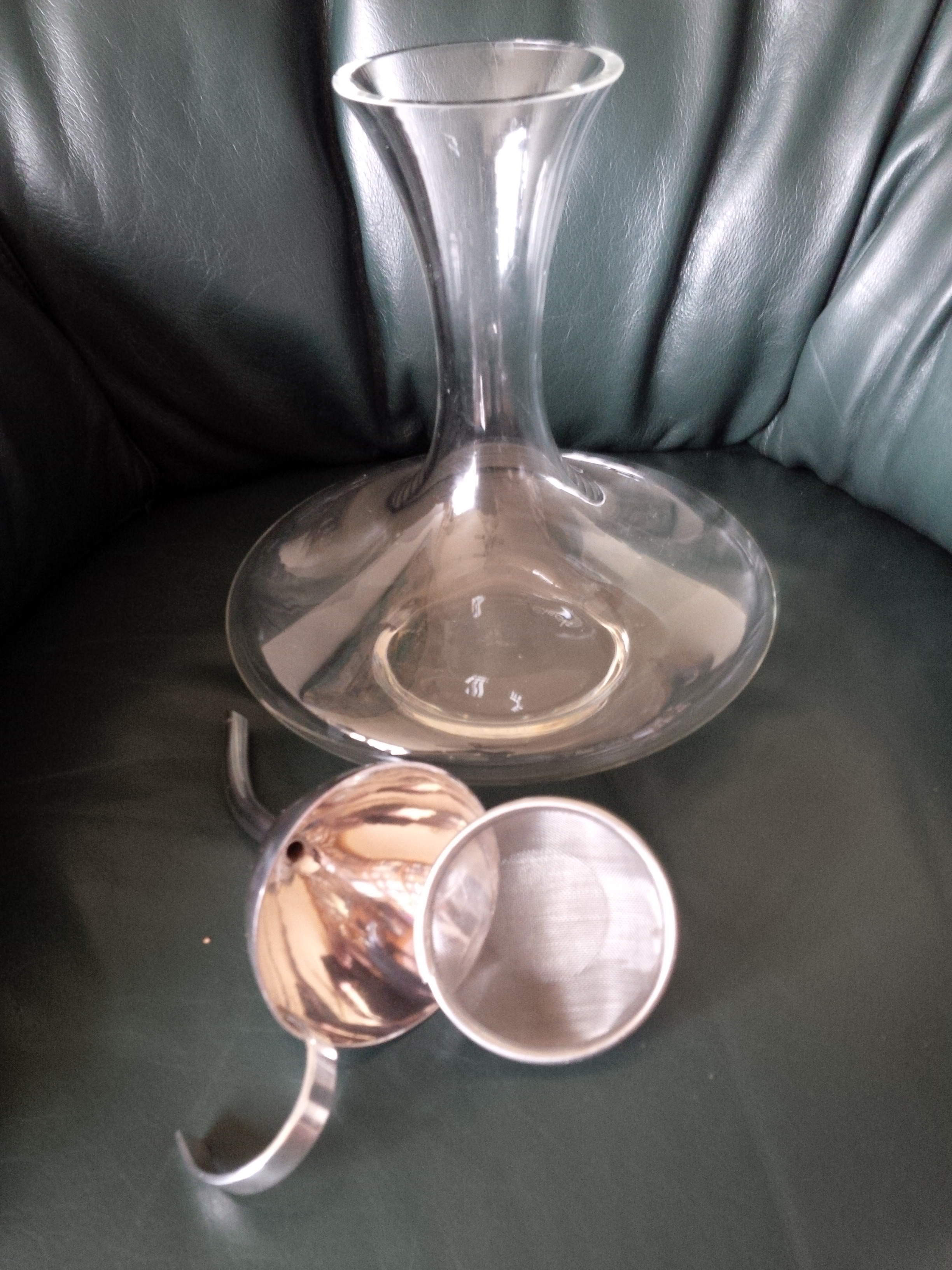
I you’re like me that’s way too much work and pomp and circumstance.  I prefer simpler methods, I generally use a wine sediment filter that I got as a gift for Christmas years ago.  It’s very functional except that it is Sterling Silver and I get to polish it way too often. Today many varieties exist and many don’t require so much effort to maintain The picture to the left show my sludge disposal set up.  I simply slide the funnel into the top of the decanter, insert the screen into the top of the funnel and pour away. If the sludge is really fine I have been known to put a two inch square patch of food grade cheesecloth inside the screen to catch the really small stuff.

I have a number of friends that think I am way too formal with the process and they get down and dirty.  If your with them or simply don’t have a wine filter (a small sieve and a plastic funnel do nicely),  take a simple coffee filter and form it into a cone and set in the top of a quart mason jar and pour the wine through the filter.  Hey it works and I will confess that I don’t see that it harms the wine.  Okay maybe I wouldn’t use this method with a first growth Grand Cru Bordeaux, but for most wines that I drink it is fine.  At the end of the day any method that get rid of the sludge and doesn’t ruin the wine works. Incidentally I made the assumption that you were entertaining and would drink the entire bottle.  If it is just you and you drink a glass or two in an evening any of these methods work fine by the glass.  In fact the first pours from the bottle will likely not need filtration at all if the bottle is well rested and bottom settled.  One final note, it really doesn’t matter what kind of sludge you find in the bottle, the filtration methods will be pretty similar and just as effective.

I hope you have enjoyed my blog posts so far and maybe even learned a trick or two.  I have a good list of topics I plan to write about in the next weeks, but I would love to have some questions and suggestions from my readers, so that I know what interests you and the kind of stuff you would like to see as I expand and improve Poor Robert’s (Wine) Almanac.

Posted in France, Hodgpodge, Uncategorized, Varietals, Winemaking, Wines | Tagged , , , , , , | 3 Comments

The Musings of a Busy LIfe — Making Time for Wine

It has been tough to find writing time these past few weeks, as making a living has gotten in the way of my passion for writing and wine. I know that some people actually make a living writing blogs, but somehow that just doesn’t seem right to me. It would then become work and less of a labor of love.  In any case, this week I am just putting some random thoughts on paper and hope that they will create enough interest and enjoyment to keep my readers coming back.

Why do so many of us love wine? Certainly it creates a sense of relaxation and stress release, but it must be more.  I’ve been drinking wine (legally) for over 45 years and it has run the gamut from the Boones Farm and Annie Green Spring of my youth to my most cherished 1963 Fonseca Ports and just about everything in between.  Admittedly some times it’s just to have something in my hand while I stand at an otherwise boring social function or charity event, but lately it has been about learning and understanding the juice of so many different grapes.  This week I experienced another step in my personal wine journey; I tasted my first  Grenache Blanc — Mutiny on the Bonny Arroyo Seco, by Randall Grahm. So why did I find it noteworthy enough to write about, it’s just another white wine right? Well actually it’s not, but it created a really new adventure for me.  It came from a different grape than I had ever experienced.  Most of the time when I taste a new wine it’s a new winemakers version of a varietal I am familiar with and I focus on what makes it unique from all the others in the varietal class it shares. In this case I am getting a whole new taste and set of characteristics to focus on.

When I first opened the bottle I found myself trying to put it in my usual set of pigeonholes.  Did it taste like Chardonnay, a Sauvignon Blanc, a Moscato or even a Riesling?  not until I stopped comparing it did I really get to focus on the unique characteristics of this grape. To be honest it was different enough that I first had to decide whether I liked it, or whether that even mattered.  In the end I decided I did, but it didn’t as I had just embarked on a new tasting experience.  Now I get to seek out other Grenache Blancs and then I’ll be able to get into comparing, but until I do I get to focus on learning about the grape, the wine that it produces and it’s unique characteristics and challenges. For me this is part of my love of wine, the adventure of discovery and appreciation.  I began to understand that my love of wine mimics my reality, a love of learning and trying new things. I also remembered some life lessons that may have faded to the back of my consciousness in the “hurry up” pace of lie today.

In a world where everything has become one size fits all and sound bites, sometimes we need to stop and reflect on a few of the details.  Yes, Mutiny on the Bonny Arroyo Seco is a white wine, just like my old 1960 Rambler Super is a car or my home is just a house, but the comparison stops there.  I get letters at the office every day and some I simply file in the “Correspondence In”, while others I put into matter specific or person specific files.  How do I make those decisions and why.  It seems more and more it gets to be reactive rather than decisive.  I am in a hurry and I need to get the paper off my desk or more likely my e-mail out of my “in-box”.  With my wine, I find that I am doing the same thing too frequently, but when I stop and “smell the bouquet” so to speak, the experience is more fun and the wine actually tastes better.  I think wine, for me, replicates life or perhaps wine replicates wine.  There are so many out there to taste and experience that I will never run out of opportunities to learn and enjoy.  Why do I always tend to default back to the ones I know I like?  Simply, I don’t need to think about it, I know I like it so I can just drink it and be done with it.

I guess the point of my ramblings comes down to a need to slow down and realize that we have so many opportunities to experience life or taste a new and different wine.  Life is finite and the opportunities endless, so slow down and make decisions to try new things and yes, new varieties of wine.  Life will be fuller, your brain will be challenged and you will grow from the new experiences.  Even if you discover that the something new is not to your liking, now you know and it helps you move forward on this wonderful life journey we all make, separately and together.

Try a new wine and then walk a different path, I promise you will learn something new.

Posted in Hodgpodge, Life Balance, Naked Wines, Uncategorized, Varietals, Winemaking, Wines, Words | Tagged , , , , | 4 Comments

Virgile’s Vineyard, A Year in Languedoc Wine Country — A Review.

Last year when I hooked up with Naked Wines, one of the first wines I tasted came from Virgile Joly, a Merlot produced and the Languedoc Region of France.  It was a marvelous fun wine, as the winemaker intended, for everyday drinking.  The more I aerated it, or left some in the bottle for a day or two the more the character of the wine changed.  As time passed, I developed an on-line relationship with Virgile and we e-talked about a lot of wine related things and his organic philosophy.  this ideas permeated his entire wine making process beginning with the wintering of the vines, pruning disease control, processing , fermentation and the list goes on.

Earlier this month I got a package in the mail that I didn’t expect.  You can imagine my surprise when I open it and there lay a copy of book entitled Virgile’s Vineyard, a Year in Languedoc  Wine Country, by Patrick Moon.  Virgile had inscribed it to me because I was his first Naked Wine Archangel (a sponsor or promoter).  I was both honored and thrilled as I leafed through this fun looking book.  To digress, I had read both Peter Mayle’s books “A Year in Provence” and “Toujours Provence” and had enjoyed them immensely, a quick look at the back cover of the book and I knew it would be a similar kind of tale.  Well, I jumped right in and immediately noted the similarity between Mayle’s story telling style and Peter Moon’s, I couldn’t wait to begin reading.  I must confess that the fact that the story followed a year of his apprenticeship in  wine making by Virgile Joly would by itself keep my attention.

The Story begins with Peter moving into a house in the Languedoc Wine Country left to him by his uncle. The house and acreage were in horrible disrepair leaving him with a years worth of  work to bring it back to its true character. This of course brings back immediately the opening to “A Year In Provence”  but this is pretty much where the similarity ends.  The story while focused on the author’s year serving as Virgile’s volunteer laborer so he could learn about wine making,  nicely intertwines his adventures with a whole cast of characters, that bring local color and humor to the story.  As the story takes a whole year, it moves back and forth between his time with Virgile and his exploration of the local  culture, people, wines and traditions of the region.  While others pop in and out of the story, Manu, his neighbor who never met a wine (especially free ones) he didn’t like and was more than happy to filch almost anything from his gullible new neighbor, a newly divorced historian who owns the local Chateau and has designs on the authors affections (clearly a one way street) and finally Virgile who develops a genuine friendship  for Peter Moon and is willing to share his enological knowledge with the author, compose that main foils who compete for his time as the story unfolds.

Aside from the fun and humorous escapades that the story develops, the book presents very nice little history of the region and  its grapes,  the life year around, in the Mediterranean hills with its winds, rain and blistering summer heat.  That said the book’s best part came in the  captivating lessons on vine tending and wine making as presented through the eyes and organic philosophy of Virgile Joly a young adventurous grower and winemaker.  This story really rang true for me as I already possessed a smattering of it from my on-line time with Virgile as he tutored me on how he makes wine and how he sees the traditions and processes playing out in the character of his wines.

All in all, “Virgile’s Vineyard …” was fun, made me laugh, and gave me pause as I learned Virgile’s methods, and philosophy right along with the author.  I had more than a few “Ah-ha” moments along the way.  In addition to all this, it made me want to buy a plane ticket and go visit Virgile in his native environment and spend time tripping around the region with Manu tasting the local wines, seeing, experiencing, and enjoying the local history and traditions.

If any of my blog readers do read the book, please add you reviews and comments, as I would be very interested in other opinions from those who, know little of Virgile Joly, his ecological philosophy, or his wines.

Posted in France, Hodgpodge, Naked Wines, Travel, Uncategorized, Varietals, Wine Books, Winemaking, Wines | 1 Comment

Wine for the Common Man — A Historical Perspective

Wine for the masses has a long history dating back to before the birth of the modern world when it serve as both a beverage with food, as a major medicinal cure all and many ceremonial purposes.  The early evidence of humans turning grapes into wine dates to at least 7000 BC.   If you hit the internet there is some pretty interesting stuff out there about all the assorted cultural traditions centered around wine emanating from the ancient and medieval world that span from the far east to europe. Many of those either focused on religious rites or just the common usage and pretty basic fermentation processes.  Trust me the wine making practices and purity laws of the time pale by comparison to what we see today.  I have to believe that given the inconsistency of the fermentation variables that some of it must have been pretty awful.  I also assume that the commoners got what was left after the ruling class got done taking the best and most consistent for rituals and regal consumption.

Don’t get me wrong I am not slamming royalty or those who in the past 9000 years or so could afford really high quality wine.  My point — I see a movement back to basics with many more really good wines being made available at prices most everyone can afford, if only for special occasions.  Part of this is due to the production standards improving, in part due to greater world wide production but mostly I believe it to be improvements in the distribution chain. Wine Shops, Drugstore chains Grocery stores and even corner markets have broadedned their inventory a lot over just my lifetime.  I even remember the days when you could only get wine in the State owned Liquor stores (I’m told some still have that problem), and believe me the variety was quite limited.  For most  of the Western World, those days are gone (thankfully).

The proliferation of “Wine Clubs”,  “Wine Buying Groups”  and the loosening of  State Wine and Beer monopolies and distribution law make it possible now to get wine from many sources on the internet and have it shipped directly to your home or business.  I frankly like the trend as it allow for a more open and competitive marketplace.  It not only increases the supply in the market, it allows small producers to find buyers in a way that they never could before. With this loosening of the moral restrictions comes a greater appreciation of different types of wines and an increase in demand for varieties that we never knew about or had the opportunity to try.

Like all things in the modern world a lot of our consumption gets driven by advertising and brand awareness.  This in turn produces more consumers who recognize a wine by name and reach for it and this crosses all sectors of the economic spectrum.  My biggest concern centers around the vineyard owners and winemakers who in this type of market see the retail prices rise but no more, or in some cases even less, gets to the producers.  I harken back to a comment I made the first time I came across a coffee cart in Seattle with this green astrological symbol for a logo — “ there is no #%@^ way I am paying $2.00 for a cup of coffee with warm milk in it”  Well I’ve eaten my words many times over and long for the days when I could get that cup for $2.00.  My point in all this; over time the Latte’ became a reality of life all over the world and and now people don’t even think about it. Today the coffee producers still struggle in the marketplace to get a fair price for their product and I remain skeptical that the same thing might occur in the world of wine.

Before I get bashed by the wine distributors and  the production winemakers  I am not saying that they are villains or even that they are the problem, the consumer will be just as much at fault in an open market economy where demand pushes prices up but supply excesses bring them down.  As the wine industry grows and access continues to increase, both these factors will come into play and the wine business will likely go the way of coffee with pressure being applied by the weight of the industry on those at the bottom of the food chain.

I am a big fan of being able to buy stuff directly from the producer and really like the trends I see for sustainability in the food markets.  It is not about the price, I do understand that I am paying more or at least as much for the food products I buy directly from producers.  What makes a difference to me is in knowing that a bigger piece of the pie goes to the producer and almost as important being able to know the producers and getting more options to provide feedback to the marketplace.  Can you even imagine going into a chain supermarket and making a comment with an expectation that it would get back to the grower, or even the packager?  I suspect that the chain market doesn’t even know who they are, as many brands are now packaged in the same plants and just labeled differently.  My point in all this is I see trends in the wine industry much like NakedWines.Com where the distance between my table and the grapegrower and winemaker gets a lot shorter.  NakedWines.Com is by no means the only model as I find that individual small vineyards and winemaker have websites where I actually buy direct and even occasionally I get to speak with them on the phone when I want mixed cases or the like.  This is my ideal wine world.

As a final note on access, I do love good wine, and in my home I like my good wine to be affordable.   I do  go to restaurants and drink wine at much higher prices (sometime outrageous).  I do also stop by specialty wine stores on occasion and buy a unique bottle of wine that I really like or it is just that special (at least I think it is). Sometime is is not about price but about desire.  Being a wine lover today lets you get more for your money everyday so that when you need (want) to spend a lot for a nice wine at dinner, or a great bottle for a special occasion, you can do so without guilt as you more than made up for it by getting your day to day good wines for less in a more direct market.


Posted in France, Hodgpodge, Life Balance, Uncategorized, Varietals, Wine Buying, Winemaking, Wines | Tagged , , , , , , , | Leave a comment

Corks or Screw Caps — A Timeless Debate

Screw Caps or Corks; one question I will never ask a group of wine drinker after a couple bottles of wine.  Everybody has an opinion and nobody will ever admit that they are wrong. I’ve been following a discussion on this subject on one of the wine forums I follow and the responses have been interesting.  There remain a few purists who believe that natural cork is the only proper way to seal wine in a bottle, some in the middle will admit that the new plastic corks will do, but they really prefer natural cork and then there are the rest that really care about the quality of the wine rather than how it’s sealed in the bottle.  Oh I forgot there also remains a number of cork fans who want natural cork because they use them for other things like crafts and stoppers for other glass containers.  I confess I have no good argument to make in defense of Screw Caps with this group as I see no practical application  for them in the craft and stopper arena.

Seriously I am really no expert on the subject and so I turned to a couple of winemakers to chime in and give me their perspective.  Randall Grahm, a long time winemaker and the producer of a host of my favorite wines, including a Grenache, Syrah, Mourvedre (GSM) blend that starts my heart fluttering every time I take one out of my cellar, offered a great perspective which I quote below:

Randall Grahm — “The question of cork vs. screw-cap is enormously complex, and there are a number of technical reasons why one might elect to use one over the other. In brief, the use of screw-caps enable a winemaker to avoid some of the technical problem of corks – leakage, and potential TCA contamination. Further, (this is a bit counter-intuitive), wines sealed with screw-caps are in fact generally (mostly) capable of longer ageing than those sealed with corks, and can be bottled with lower levels of protective SO2. (This is a beautiful thing.) But in winemaking as in life, there are always trade-offs. (There is no free lunch.) Wines sealed with screw-caps, if we use the very tight liner behave somewhat differently than wines sealed with a cork. (Note, there are various liners available for screw-caps, allowing differential amts. of oxygen permeation, so not all screw-caps are created equal). Screw-capped wines are often a bit more reticent, or “closed” upon opening. In extreme cases, they might even express a slightly rude aroma of “reduction.” (Note, this is generally not the end of the world.) In any event, in my opinion at least, virtually all wines sealed with Saratin (the tightest screwcap liner) seem to benefit from decanting. The fact that a wine might be “closed” or reticent or even slightly “reduced” (i.e. prone to the expression of sulfide aromas) is in fact an indicator that it likely possesses the capability of living a much longer life. In my opinion at least, all things being equal, a wine sealed with a Saratin screw-cap will generally have a life-span of approximately 50% longer than the equivalent wine sealed in cork. I’m hoping that I’ve not created more confusion on this subject.

Randalls perspective doesn’t  Answer the question of which is better any better than most of the discussions I’ve had with fellow wine lovers, but it does demonstrate that both have advantages and disadvantages. Another of my favorite winemakers who just released a Killer Dry Creek Syrah with a screw cap that presents very well right out  of the bottle, (no decanting or aeration required)  gives us a more historical perspective with a more positive slant to  screw caps:

Tim Olsen — “Robert, in answer to your question about screw-caps and aging, things have come a long way. Originally patented in 1889, screw-caps came into widespread use in the 20th century. With the development of the Stelvin screwcap in the 1970’s, the wine industry started embracing the new technology. Initially it was jug wines and lower priced wines. When Plumpjack released a $135 bottle of 1994 Napa Valley Cabernet Sauvignon in the mid nineties, people realized the screwcap wasn’t just for cheap wines. Still it has been a slow adoption as issues continue to swirl around quality and aging concerns.

The short answer is any concern about screw caps and aging are all perception based. The facts are that there are a number of different liners (the plastic seal inside the screwcap that covers the bottle opening) available. The variations have different porosities which allow for differing “breathing” rates. This means that we use one kind of liner for fresh young white wines and a different liner for age worthy red wines. BTW, that 1994 Plumpjack wine is still aging and drinking well.

And lastly, the risk of cork taint (TCA) is eliminated. You actually taste what we put into the bottle instead of a wine that has some or a lot of influence from contact with the cork. As much as I love the sound of popping a cork on a nice bottle, I hate what cork (not all but too many) has done to the taste of wine. Consider this winemaker sold on screw-caps”

Given the two perspectives, it seems to me that it all comes down to what the winemaker feels comfortable with and and what systems they have available to them.  One of my wine making acquaintances from France, Virgile Joly, one told me that he uses cork because he rents a bottling plant and cork plants are what is most available in France.  Face it, bottling operations are not cheap and for small producers change will likely be slow. I suspect that younger winemakers have less of an issue with screw caps, than some of the veterans.

I’ve experienced a “corked” (Cork Taint — TCA) wine and it is not pleasant, either on the wallet or the palate, and eliminating that issue is just fine with me.  So I guess the issue of consistency and reliability plays strongly into my willingness to accept screw caps as a better way to go.  Anecdotally, I have also noticed that with really good wines in screw cap bottles, the shelf life is better after opening.  I’ve had both red and whites last for up to two weeks in screw capped bottles with no negative impact on the flavor.  I would also note that with young reds I actually believe they get better a few days after opening because of the acceleration of their maturity due to air exposure.

I hope this post  generates some good online debate and discussion because as Randall Grahm noted, the issue is far from over and “is enormously complex”.

Posted in Hodgpodge, Naked Wines, Uncategorized, Wine Books, Wine Buying, Winemaking, Wines | Tagged , , , , , , , | 12 Comments

A Tribute to Naked Wines.Com — An Inspiration

A while back the State of Montana decided to come out of the dark ages and allow the direct importation of wine by its residents.  It opened up a whole new world of wine to many adventurous wine commoners like me.  After the wine world opened up I bounced around a few websites and found options for case lots from a lot of different wineries, or options to join wine clubs and get their selection of the month.  One day my wife got a groupon in one of the many “val-pac” type junk mailing we get at the house.  We both laughed at this particular groupon; it came to her and she doesn’t like the acidity of alcohol and thus doesn’t drink.  For reasons that I really don’t remember, I took the groupon and tossed it on the desk in my study.

Fast forward a couple of weeks and I am at the desk cleaning it off so I can do some writing and I stumble across the  Naked Wines groupon.  I am already at my computer so I pull up Naked Wines’ Website and in about an hour my life changes in many positive ways.  I ordered an assorted case of wine, they gave me the groupon discount and upgraded my 12 bottle case to a 15 bottle case and let me pick 3 more wines at no additional cost and presto I wind up with 15 great bottles of wine for about $60.00 net out of pocket.  Along the way I learn about the  Naked Wines’ Crowd (cloud in their case) funding model that assists new wine makers get started and at the same time lets their Angels spend every dime they contribute to the cause on wine those same winemakers produce.  It looks like a no lose deal to me so I agree to chip in $40 each month directly debited every month with the understanding (guarantee) that if I am not happy with the deal they will give me the money back at any time. I’m excited and happily waiting for my wine to arrive (five days later).

The same day I placed the order I got an e-mail from Naked Wines and I thought great the spam is starting already.  To my surprise it was a nice introductory e-mail (canned I am sure) from the Founder Rowan Gormley welcoming me to the  Naked Wines family of “Angels” and giving me the lowdown on how to get the most out of Naked Wines. I start exploring the Naked Wine Website and light on a group called Naked Newbies (that is no typo) and thought how corny can it get. I jump into the group (what the heck – it can’t hurt) introduce myself and almost immediately I got welcoming replies from a host of Angels and the conversation began.  I have stayed involved in Naked Newbies ever since and I joined a number of their groups (forums to most) which include wine and cigars, winemakers, wine and food pairing and even a two year tasting group (led by a winemaker) that follows a single wine for two years to experience what winemakers do as they watch a wine mature.  Being a part of the Naked Wine host of Angels is a little like being in a wine focused adults only Facebook or a LinkedIn. The social media aspects of the groups afforded me the opportunity to learn a lot about wine, meet a bunch of really nice people who I may never actually meet, but who have become good social friends.

The second part of this story really started when I got my first case of wine.  I must digress a moment; when you go to a wine shop or a grocery store (the best wine selections in my city) you find the really good stuff at eye level (top shelf), the good stuff fills the shelves right below eye level (middle shelf), and the stuff in boxes and factory wines sit on the floor in front in cases or on the very bottom tier (lower shelf).  Hey it is all about marketing and catching your eye.  Well back to the story, I have a top shelf appetite and a middle to bottom shelf budget, so when the wine arrived, I had hopes that the wine would be okay.  Well I was blown away, the Naked Wine marketing line about getting great new winemakers who want to produce boutique wines is no hype.  They have done it in spades.  I have never gotten a bad wine from them and I have gotten many that are better than anything I can buy off the top shelf and some occupy rare air, in a league with those special wines that they lock up in a glass front case at the wine store.  These wine makers, from all over the world, produce small batches (2500 cases or less) exclusively for  Naked Wines.  The Angels buy it (actually anybody can buy it at retail) at reduced prices because there is minimal marketing cost to the winemaker or the consumer and because of the Angel funding mechanism. As a semi-retired executive, I get the business model and as a wine lover, I get great wine with no pressure or push.  What’s not to like about the deal?

…”and now the rest of the story” (ala Paul Harvey).  I have actually been able to get to know the winemakers of my favorite wines, and I converse with them regularly and get their perspective on the next vintages of their wines.  Most interesting to me is that I get to rate and review their wines in a public forum that allows new Angels to see what I think and the winemakers respond to these reviews and actually ask questions about what I like and don’t (qualities of their wines) like about the particular wine and seem genuinely interested in what I as a consumer (not a professional taster) think.  I have to tell you that rating a wine is easy (I either like it or I don’t), but reviewing them has been a pretty steep learning curve.  What do I know of “nose” “tannins”, “bouquet” and how do I tell if a wine has notes of “pear”, “apple”, “black current” or “Cassis?  Well I’ve learned from my fellow Angels and I’ve even surprised myself by sharing some of my knowledge acquired over about 50 years of world-wide business travel drinking wines I would never order for myself because of cost.

I owe the idea for this website and blog and my ability to really experience world class wines at reasonable prices to Naked Wines. I promise this website will not be a promotional venue for Naked Wineor any other winery or wine maker.  It will be exactly what it’s billed to be, a place for ordinary folks like me and most of the other Naked Wines Angels to go for basic wine information without feeling like a question might be considered dumb or stupid.  Nobody needs to worry about that, I’ve already asked all the dumb and stupid questions that anybody can think of that relates to wine.

One last note about  Naked Wines and then I’ll quit singing their praises, if anybody decides to check out the sight, don’t buy anything until you let me know and I’ll make sure that you get a groupon like I did so you get the most bang for your buck if you decide to give them a try.  If you do, you will have a great experience and will sample some fantastic wines.

Posted in Naked Wines, Wines | Tagged , , , , , | 20 Comments